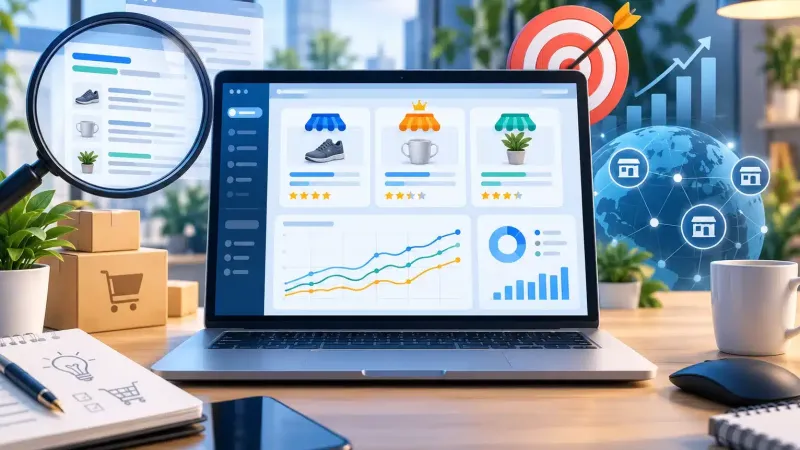
Hello, small business owners! Good news came out of Jakarta last week: the government has officially made artificial intelligence a key tool for growing Indonesia's SME exports, meaning exports by small businesses (UMKM). On Wednesday 9 September 2026, the Ministry of Trade, together with Meta Indonesia and UKMIndonesia.id, launched a mentoring programme called “Gapai Pasar Global dengan AI” (Reach Global Markets with AI) at the ministry's office in Jakarta. If your products are good but you keep selling to the same few buyers, this is worth reading to the end.
Why? Because exports from Indonesian small businesses are still far below their potential. And interestingly, the biggest obstacle turns out to have little to do with product quality.
What happened: AI becomes a new route for SME exports
Trade Minister Budi Santoso said digital technology can help small businesses reach a wider pool of consumers, including international buyers. In his view, AI can be used for market research, content creation, planning ad strategy and even communicating with prospective buyers in target countries.
The mentoring programme covers 200 businesses in Bandung, Batam and Jakarta. For the Jakarta series alone, 100 participants were selected from 580 applicants, so interest is clearly high. The material is practical too: workshops on global market research, building a digital catalogue and hands-on advertising with Meta Advantage+. Afterwards, participants get seven days of intensive mentoring to optimise their ads and attract potential buyers. The results will be presented as an SME Export Catalogue during Trade Expo Indonesia 2026, 14–18 October 2026.
The most striking point came from Meta Indonesia. Berni Moestafa, Head of Public Policy and Government Relations for Meta in Indonesia and the Philippines, said the challenge they kept running into while mentoring businesses in Batam and Bandung was whether potential customers could find the products at all. Product quality was not the issue.
The numbers you need to know
For the full picture, here are some of the latest figures behind this year's push for SME exports:
- Small businesses contributed only 15.7 percent of Indonesia's export value in 2025 (Ministry of Trade, 2026).
- That is still behind Thailand (29 percent) and the Philippines (20 percent) (Coordinating Ministry for Economic Affairs, 2025).
- 94.76 percent of online businesses in Indonesia still rely on messaging apps as their main channel, and only 1.36 percent have a well-managed website (BPS, Statistics Indonesia, 2024, cited in the Ministry of Trade's 2025 PMSE e-commerce performance report).
- More than 90 percent of small businesses in Indonesia reportedly do not yet use AI in their operations (Ministry of SMEs, cited by ANTARA, July 2026).
Read the third point again, slowly. If only 1.36 percent of online businesses have their own “home” on the internet, most Indonesian products really are hard for overseas buyers to find, because those buyers usually search through Google and online catalogues, not chat groups.
Why good products do not always reach global buyers
This is the most misunderstood part of SME exports. Overseas buyers follow a different path from the customers in your neighbourhood. They usually start with a search engine, read the company profile, check the catalogue and specifications, and only then get in touch. If your business does not appear at that first step, the journey ends before it has begun.
The three most common obstacles
First, there is no page to find. A social media profile alone is often not enough to convince a buyer who needs documents and detail. Second, the product information is not available in full in a language they understand: size, materials, production capacity and minimum order are all vague. Third, there is no proof of credibility: no certifications, no photos of the production process and no testimonials anyone can check.
The good news is that all three can be fixed, and this is exactly where AI helps most.
7 steps to use AI to grow your SME exports
Here is a realistic order of work for a small business owner, with no need for a big team. Work through the steps in order and do not skip ahead.
1. Use AI for market research instead of guessing
Before you choose a target country, ask AI to summarise demand, competitors and price ranges in a few markets. You are not looking for a final answer here. The aim is to narrow ten countries down to two. Then check the findings against official sources such as Indonesian trade attachés or the Indonesia Trade Promotion Center (ITPC).
2. Translate product terms correctly
AI is very useful for translation, but do not stop at a raw translation. Check the technical terms specific to your industry, because the names of materials, units and quality standards often have established equivalents that differ from a literal translation. A wrong term in your catalogue can make a buyer hesitate from the very first minute, and it is one of the reasons SME exports fail at the earliest stage.
3. Put together a tidy digital catalogue
Create one catalogue with clean photos, specifications, monthly production capacity, minimum order and shipping options. AI can help draft the descriptions and tidy up the structure; you only need to correct the figures that only you know. This is an important foundation for SME exports that often gets missed.
4. Build your own site instead of only borrowing space
Marketplaces and social media are good for reach, but serious buyers usually want to see an official website. A well-organised company website gives you a permanent home for your catalogue, company profile and request-for-quotation form. Serious buyers usually compare several suppliers at once, so a clear page immediately improves your chances of making the shortlist.
5. Optimise your pages so they show up in search
A good page still needs to be found. Write your titles, descriptions and heading structure using the words prospective buyers actually type. You can follow a practical guide in on-page SEO techniques, and to speed up keyword research and drafting, use AI tools for SEO. This step is what stops your exports depending on a single trade fair once a year.
6. Test the market with small-budget ads
Before spending big, run targeted ads in your chosen country on a controlled budget for two to four weeks. Look beyond the number of clicks to how many requests for quotation come in, because that is the most honest sign that your exports are starting to move. If you are just starting out, our Google Ads guide for Indonesian businesses is a safe place to begin.
7. Prepare quick, consistent replies
Time zone differences make slow replies feel even slower. Prepare standard answers to common questions, then use simple automation or a chatbot on your website to capture enquiries outside working hours. Buyers judge how serious you are by how quickly and clearly you respond, and many export opportunities are lost simply because a reply came three days late.
Mistakes that stall SME exports
A few patterns keep repeating. Handing all the copy over to AI without checking it, so claims or figures appear that do not match what you actually produce. Chasing too many countries at once with limited people. Creating a catalogue once and never updating it when material prices change. And, most often, waiting until everything is perfect before starting, when a simple, accurate catalogue is far more useful than a big plan that never gets going.
One more: forgetting the technical side. A site that loads slowly from overseas sends potential buyers away before they ever see your products. Check your business website's speed regularly too.
Where to start today
Pick one flagship product rather than your whole range. Write its description in two languages, add photos and honest specifications, put it on a single page anyone can open, then test it with a small ad campaign in one country. Those four steps alone put your business ahead of most competitors who still rely on chat groups.
The timing is good. The government is pushing, the big platforms provide the tools, and trying it costs far less than it did five years ago. Exporting is no longer reserved for big factories. It comes down to whose products are easiest to find and explain themselves most clearly. If you would like help preparing your digital home and catalogue, the Webzoo team is happy to start with a relaxed chat about what you need.
References
- Ministry of Trade of the Republic of Indonesia: “Mendag Busan Dorong Optimalisasi AI untuk Pemasaran Produk UMKM” (Trade Minister encourages using AI to market SME products), 9 September 2026
- Coordinating Ministry for Economic Affairs of the Republic of Indonesia: “Pemerintah Dorong UMKM Naik Kelas, Tingkatkan Kontribusi terhadap Ekspor Indonesia” (Government helps SMEs grow and raise their share of Indonesian exports)
- Statistics Indonesia (BPS) (2024), cited in the Ministry of Trade's Electronic Commerce (PMSE) Performance Report, 2025
- Ministry of SMEs, cited by ANTARA News, July 2026: data on AI use by Indonesian small businesses