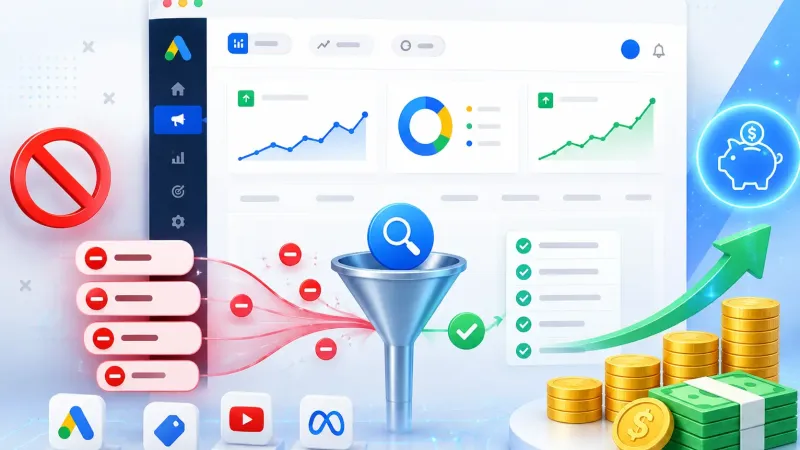
Spent millions of rupiah on Google ads and got nothing back? Plenty of small business (UMKM) owners and Indonesian startups have been there. Google Ads itself is rarely the problem. Usually the campaign was run without a proper strategy, and this Google Ads guide for Indonesian businesses is here to fix that. As the digital marketing team at Webzoo.id, we have pulled together everything you need to know: how it works, how the costs are structured, which bidding strategies to use and how to optimise your ads so you do not waste budget. In this guide you will learn how to set up an account, choose the right campaign type, understand Quality Score and measure your advertising ROI accurately.

- Google holds 97.09% of the search market in Indonesia, making it the most strategic digital channel for advertising your business.
- Google Search Ads in Indonesia usually cost less per click than in global markets, although the figure depends heavily on the industry.
- Use Google Ads for quick results and SEO for long-term growth. The best businesses run both.
- Quality Score decides your ad position and cost per click. A high score means paying less, even with a lower bid.
- Performance Max is Google's AI-driven campaign format, and any serious advertiser needs to understand it.
What Google Ads is and how it works
Google Ads is Google's paid advertising platform. It shows your ads on Google search results, YouTube and millions of partner sites, and you only pay when someone clicks an ad (pay-per-click). With Google Ads, your business can reach potential customers who are actively searching for your products or services, right at the moment their intent to buy is highest.
Google Ads runs on an auction system. Every time someone types a keyword into Google, the platform runs a micro-auction in a matter of milliseconds. Google decides which ads appear based on two main factors: the bid and how relevant the ad is to the user's search. So a big budget is not the only thing that counts. Ad quality matters just as much.
The process goes like this. You set your target keywords and a maximum bid per click. When a user searches for one of those keywords, Google calculates your Ad Rank from your bid multiplied by your Quality Score. The ad with the highest Ad Rank takes the top spot. Interestingly, you often pay less than your maximum bid, because Google only charges slightly more than the Ad Rank of the competitor just below you.
The main components of a Google Ads account
A Google Ads account has three levels. The first is the Campaign, where you set the daily budget, network type and target locations. The second is the Ad Group, a set of keywords that share a theme. The third is the Ad itself, the text or visual that users see. Understanding this hierarchy is crucial before you build your first campaign.
Many beginners go straight to writing catchy ad copy, yet a tidy campaign structure does far more for long-term success. Campaigns whose Ad Groups are split by specific themes consistently earn higher Quality Scores than campaigns that lump every keyword into a single Ad Group.
Why do Indonesian businesses need Google Ads?
Google held 97.09% of the search market in Indonesia in 2025 (StatCounter, 2025), which makes it the most dominant digital channel available to you. In practice, almost all of your potential customers use Google to look for products or services before they buy. If you are not there, you are handing that market to your competitors.
The biggest advantage Google Ads has over other ad platforms is search intent. Someone typing “logo design services Surabaya” or “buy affordable minimalist sofa” is actively looking for a solution. They are not a passive audience, as people scrolling social media are. That is why conversions from Google Ads tend to be higher, especially for local businesses and e-commerce.
On cost, Indonesia has some of the most competitively priced clicks in the world. Google Search Ads in Indonesia usually cost less per click than in global markets, and Display Ads usually cost even less. The figure depends heavily on the industry and the keyword, as the cost table below shows. That gives small businesses with limited budgets a chance to compete on the same level as the big players.
Types of Google Ads campaigns
Google Ads offers five main campaign types, each designed for a different goal (Google Ads Help Center, 2025). Choosing the wrong type is the most common reason ad budgets get wasted, so understand the differences before deciding which one fits your business goals.
| Campaign type | Where it appears | Ad format | Estimated CPC (Indonesia) | Best for |
|---|---|---|---|---|
| Search Ads | Google search results | Text | Rp 800/click | Lead generation, local services |
| Display Ads | Google Display Network (2M+ sites) | Banners/images | Rp 150/click | Brand awareness, remarketing |
| Video Ads | YouTube & Google Video Partners | Video | Rp 30/view | Brand storytelling, visual products |
| Shopping Ads | Google Shopping, Search | Product + price | Rp 500–Rp 1,200/click | E-commerce, online shops |
| Performance Max | All Google networks | Multi-format | Varies | Businesses that need broad reach |
Search Ads: the most popular choice for small businesses
Search Ads are the campaign type Indonesian businesses use most, because they reach users with high intent directly. The ads appear at the top or bottom of Google search results with a “Sponsored” label. Because they are text-based, they are easy to create without any special visual assets: all you need is a headline, a description and a relevant destination URL.
Display Ads: ideal for remarketing
Display Ads reach users while they browse other websites, read articles or use apps. The Google Display Network covers more than two million sites and apps. These campaigns work very well for remarketing, which means showing ads again to people who have visited your site but have not bought anything yet.
How to sign up and create a Google Ads account
All you need to create a Google Ads account is a Google account and about 15 minutes. The minimum top-up, or initial deposit, for a Google Ads account in Indonesia is Rp 100,000 (Google Ads Help, 2025), a very manageable amount for your first experiment. Here are the steps to follow.
- Go to ads.google.com and click “Start now”.
- Sign in with your business Google account (use a business email, not a personal Gmail address).
- Choose your main advertising goal: sales, leads, website traffic or brand awareness.
- Fill in your business details: business name, website URL and industry category.
- Choose your first keywords. Google will suggest some based on your website.
- Set your target area (a city, a province or the whole of Indonesia).
- Write your first ad: 3 headlines (max. 30 characters each) and 2 descriptions (max. 90 characters each).
- Set a daily budget and a payment method (credit card or bank transfer).
- Submit the campaign and wait for Google's review.
Once the account is active, connect Google Ads to Google Analytics 4 straight away and set up conversion tracking. Without these two, you cannot tell whether your ads are producing real leads or sales. Do not skip this step. Many beginners do, and end up with campaigns they cannot optimise.
Keyword research with Google Keyword Planner
Google Keyword Planner is a free keyword research tool built into Google Ads. It shows search volume, competition level and estimated CPC for each keyword (support.google.com/google-ads, 2025).
Open Keyword Planner from the “Tools” menu in your Google Ads dashboard. Enter a seed keyword or your website URL, then choose Indonesia as the country and Indonesian or English as the language, depending on your target audience. Google will return hundreds of keyword suggestions, each with monthly search volume, competition (Low/Medium/High) and the CPC range you can expect.
How to choose profitable keywords
Choose keywords with clear intent. Transactional keywords such as “buy affordable gaming laptop Jakarta” or “AC service Bandung” are worth far more than informational ones such as “what is a gaming laptop”. If you are a small business on a limited budget, focus on more specific long-tail keywords (3+ words). Competition is lower and they usually convert better.
Negative keywords: your shield against wasted budget
Negative keywords stop your ads from appearing for irrelevant searches. For example, if you sell new laptops, add “used”, “broken” and “second-hand” as negative keywords. This prevents wasted clicks from people who will never become buyers. Always build a negative keyword list before your first campaign goes live.
How to create a Google Ads ad step by step
The CTR of Google Search ads can vary widely between advertisers in the same industry. The difference comes down to the ad copy and to how well the keyword, ad text and landing page fit together. These three elements need to carry one consistent message.
Writing effective ad copy
Google Responsive Search Ads (RSA) let you write up to 15 headline variations and 4 descriptions. Google tests the combinations automatically and works out which ones perform best. Make full use of this. Put your main keyword in at least one headline, add a unique value proposition and finish with a clear call to action such as “Call Now” or “Get a Free Quote”.
Ad extensions: more clicks at no extra cost
Ad extensions, also called ad assets, add extra information that makes your ad bigger on the SERP at no additional cost. Use Sitelink Extensions to point people to specific product pages, Callout Extensions to highlight strengths such as “Free Shipping” or “1-Year Warranty”, and Call Extensions to show your phone number right in the ad. Because the ad takes up more space, active extensions usually lift CTR as well.
A relevant landing page: the key to conversions
Even the best ad is wasted if the landing page is not relevant. Make sure the destination page contains your main keyword, loads in under 3 seconds and shows a clear CTA. How well the ad and landing page match also has a direct effect on your Quality Score. If you do not yet have an optimised WordPress website, consider building one before you run paid ads.
Google Ads bidding strategies: which one is right?
Google Ads offers several automated bidding strategies that use machine learning to optimise bids in real time (Google Ads Help Center, 2025). These are the main options.
- Target CPA (Cost Per Acquisition): Google optimises your bids so that each conversion costs no more than the amount you set. A good fit if you know the average value of a lead or a sale.
- Target ROAS (Return on Ad Spend): Ideal for e-commerce. Google maximises revenue while keeping the ratio of revenue to ad spend in line with your target.
- Maximize Conversions: Google spends your entire daily budget to get as many conversions as possible. Good for new campaigns that have no historical data yet.
- Maximize Clicks: Suits brand awareness campaigns, or cases where the main goal is website traffic rather than direct conversions.
- Manual CPC: You control every bid for every keyword yourself. It gives you maximum control, but it takes more management time.
As a general rule, new businesses without conversion data should start with Maximize Conversions for the first 2-4 weeks. Once the campaign has collected at least 30-50 conversions, switch to Target CPA or Target ROAS for more precise optimisation.
Understanding Quality Score and Ad Rank
Quality Score is Google's rating (on a scale of 1-10) of how relevant and good your ad is, and it directly determines your ad position and cost per click (support.google.com/google-ads, 2025). An ad with a Quality Score of 8 can outrank a competitor bidding twice as much. It is a competitive advantage that many small businesses in Indonesia overlook.
Quality Score is built from three components. First, Expected CTR: a prediction of how often your ad will be clicked when it is shown. Second, Ad Relevance: how closely your ad text matches the keyword you are targeting. Third, Landing Page Experience: the quality of the page the ad leads to, in terms of content, speed and relevance to the ad.
The Ad Rank formula and how it affects your ad costs
Ad Rank is calculated with this formula: Ad Rank = Bid x Quality Score x Extension Impact. Your ad's position on the SERP depends on your Ad Rank relative to your competitors. More interesting still, your actual cost per click (actual CPC) is usually only what it takes to beat the Ad Rank of the competitor directly below you. In other words, a high Quality Score can bring your cost per click down significantly.
How to improve your Quality Score
Quality Score is not fixed. It can rise once you improve keyword relevance, ad text and landing pages, and a higher score usually brings your CPC down without any extra budget.
Practical steps to raise your Quality Score: group keywords with very specific themes into one Ad Group, include the keyword in your ad headlines, make sure the landing page has the main keyword in its heading and first paragraph, and optimise page speed for mobile. Mobile use in Indonesia is very high, and most searches come from mobile devices.
How much does Google Ads cost in Indonesia?
There is no fixed fee to advertise on Google Ads. You decide your own daily budget and bid per click. Even so, knowing the cost benchmarks for your industry is essential if you want a realistic budget. Below are rough estimates of CPCs and starting monthly budgets in Indonesia. Real figures can differ a great deal depending on the keyword, the city and the competition, so check the estimates for your own keywords in Keyword Planner too.
| Industry | Average CPC | Estimated monthly budget (starting out) |
|---|---|---|
| Finance & insurance | Rp 3,500–Rp 8,000 | Rp 3–5 million |
| Property | Rp 2,000–Rp 6,000 | Rp 3–7 million |
| Health & clinics | Rp 1,500–Rp 4,000 | Rp 2–4 million |
| Retail & e-commerce | Rp 500–Rp 1,500 | Rp 1.5–3 million |
| Food & beverage | Rp 400–Rp 1,000 | Rp 1–2 million |
| Technology & SaaS | Rp 1,000–Rp 3,500 | Rp 2–5 million |
| Education & courses | Rp 800–Rp 2,500 | Rp 1.5–3 million |
As the table shows, finance and property have the highest CPCs because competition for ad space is fierce and each customer is worth a lot. Food and beverage has the lowest CPC, which makes it a good starting point for small businesses trying Google Ads on a minimal budget. A local food business can start a Search Ads campaign on a budget of around Rp 1–2 million a month, in line with the table above.
How to measure Google Ads performance (CTR, CPC, ROAS)
Running ads without measuring them is simply a more organised way of wasting money. The four key metrics to check every day are CTR, CPC, conversion rate and ROAS (Google Ads Help Center, 2025). Understanding each one helps you make optimisation decisions based on data rather than assumptions.
- CTR (Click-Through Rate): The percentage of people who see your ad and click it. Formula: (Clicks / Impressions) x 100%. Industry benchmark: 2-5% for Search Ads. A low CTR suggests your ad copy is not compelling enough or your keywords are not relevant enough.
- CPC (Cost Per Click): The average amount you pay for each click. Watch the CPC trend week by week. If CPC goes up without more conversions, something is wrong with your targeting or competition has increased.
- Conversion Rate: The percentage of visitors who take the action you want (buy, sign up, get in touch). The industry average in Indonesia is 2-4%. If you are below that, check your landing page and ad relevance.
- ROAS (Return on Ad Spend): The revenue you earn for every rupiah spent on ads. Formula: Revenue / Ad Spend. A healthy ROAS target is at least 3x (300%) for most businesses.
Set up Google Ads Conversion Tracking and connect it to Google Analytics 4 so you can follow the user journey from ad click to purchase. This data is worth far more than a click count. Without proper conversion tracking, you cannot tell whether your ads are actually bringing in business or just empty traffic.
Google Ads optimisation tips to avoid wasting budget
Wasted Google Ads budget usually comes from a handful of repeated mistakes that are easy to avoid. A WordStream study found that an average of 25% of Google Ads budgets goes to waste through poor keyword targeting, irrelevant ads and missing conversion tracking. Here are concrete steps to get the most out of every rupiah you spend on ads.
- Use keyword match types correctly: Avoid Broad Match for campaigns with small budgets. Use Phrase Match or Exact Match for tighter control over which searches trigger your ads.
- Schedule ads for the hours that work: Analyse when your audience is most active and switch ads off during hours with low conversions. For B2B businesses, working hours (08.00-17.00) usually perform better.
- Update negative keywords regularly: Check the Search Terms Report every week and add irrelevant terms to your negative list. Of all the routine tasks, this one has the biggest impact on budget efficiency.
- Test at least 3 ad variations per Ad Group: Run A/B tests on headlines and descriptions. Stop the poor performers and build on the best. Google RSA handles much of this for you automatically.
- Improve Quality Score before raising your budget: Adding budget to a campaign with a low Quality Score only magnifies your losses. Fix the score first, then add budget.
Performance Max: Google's AI-driven campaign type
Performance Max (PMax) is a Google campaign type that lets a single campaign run across the whole Google network at once: Search, Display, YouTube, Gmail, Maps and Discover (Google Ads Help Center, 2025). Since it opened to all advertisers in late 2021, with ongoing updates through to 2026, PMax has become the new standard for advertisers who want maximum reach with minimal management.
PMax relies entirely on Google's AI. You supply an “asset group” containing ad text, images, logos, video (optional) and audience information. Google's AI then decides the best ad format, platform, timing and audience for each impression. Manual control is very limited, and that is a trade-off you need to weigh up.
When should you use Performance Max?
Performance Max works best when your Google Ads account already has enough conversion data (at least 50 conversions a month). Without historical data, Google's AI does not have enough “learning material” to optimise the campaign. For a new business or an account with little conversion data, start with Search Ads and add PMax after 2-3 months.
Where PMax beats conventional campaigns: full automation saves management time, a single campaign gives you multi-channel reach, and it can find new audiences you might not have targeted manually. The downsides are limited data transparency (you cannot see the specific keywords that trigger your ads) and less creative control than you get with Search Ads.

Google Ads vs SEO: which is right for your business?
Google Ads and SEO are two strategies that complement each other rather than compete. BrightEdge research found that organic search brings in more than half of all website traffic, far more than paid search (PPC). Knowing how they differ helps you allocate your digital marketing budget strategically.
| Aspect | Google Ads | SEO |
|---|---|---|
| Time to see results | 2 hours–3 days | 3–6 months |
| Cost | Pay per click (ongoing) | Setup & content costs (an investment) |
| Control over position | High (depends on budget) | Limited (Google's algorithm) |
| Type of traffic | Paid, stops when the budget runs out | Organic, keeps flowing |
| Longevity | As long as the budget is running | Sustained over the long term |
| Best for | Fast results, seasonal promotions, new products | Long-term growth, brand authority |
Ideally, a business runs both at once. Use Google Ads to bring in buyers now, while you build an organic SEO strategy that reduces your reliance on paid ads over time. If you run a WooCommerce online shop, combining Shopping Ads with product SEO is the most cost-effective strategy for e-commerce in Indonesia.
For a brand-new business that needs customers quickly, put Google Ads first. For an established business that wants to lower its customer acquisition costs over the next 12-24 months, invest in SEO as well. You do not have to pick one. A healthy marketing budget sets aside a share for each, depending on your business's stage of growth.
Running Google Ads that actually turn a profit takes a solid grasp of the auction system, keyword strategy, Quality Score optimisation and consistent analysis of your conversion data. With what you have learned in this Google Ads guide, you now have a strong foundation to start from. Remember that Google Ads is an ongoing investment, not a one-off cost. The more data your campaigns collect, the better Google's algorithm can optimise them for your business.
The most important first step is simply to start, even on a small budget. Create an account, run your first Search Ads campaign with 5-10 targeted keywords, set up conversion tracking and review the results after two weeks. Iterating and optimising on real data is worth far more than a perfect plan that never gets carried out. Good luck!
FREE CONSULTATION
Ready to run Google Ads that pay off?
The Webzoo.id team can help with everything from campaign setup to ROI optimisation
Custom campaign strategy Monthly performance reports Chat on WhatsApp 085179900047Quick replies Monday–Saturday, 08.00–17.00 WIB (Western Indonesia Time)
Webzoo.id Team | Digital Marketing Specialists who plan and manage Google Ads campaigns for businesses in Indonesia.