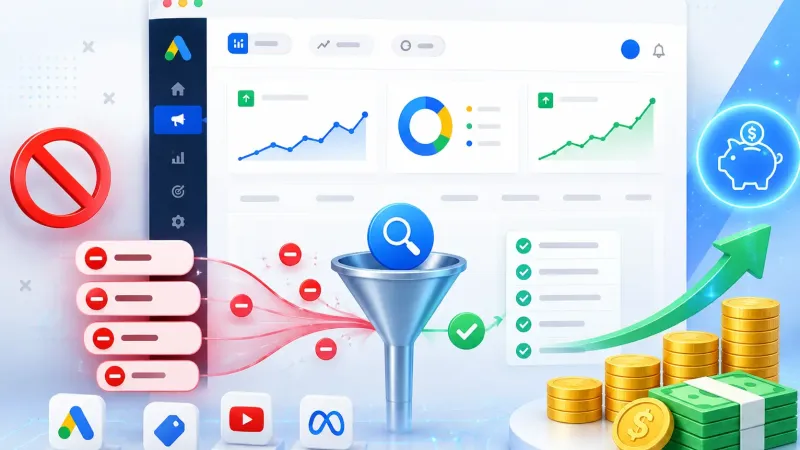
Many business owners feel their ads are “wasteful” when the real problem is how they bid, not how much they spend. Your Google Ads bidding settings decide how many rupiah you pay every time someone clicks your ad, and how often your ad shows in the positions that actually produce sales. Choose the wrong strategy and the budget runs out with nothing to show for it. Choose the right one and your cost per result can fall sharply without adding a single rupiah.
The good news is that you do not need to be a maths expert to understand it. This article breaks down the seven bidding strategies that matter most in 2026, when to use each one, and the mistakes that most often drain the ad budgets of small businesses (UMKM).
What is Google Ads bidding and why does it decide your ad costs?
Every time someone types a keyword into Google, a lightning-fast auction runs in milliseconds. The Google Ads bidding system decides whose ad appears, in what position, and how much is charged. The bid amount is only one factor; ad relevance, landing page quality and expected click-through rate count too.
This means an advertiser with a lower bid can still win if their ad is more relevant. Setting up Google Ads bidding carelessly is like burning money: you pay a lot for clicks that never turn into sales. If you are just starting out, read our Google Ads guide for Indonesian businesses first so your account is set up properly from the beginning.
Manual vs automated: what is the difference?
Manual bidding means you set the maximum cost per click for each keyword yourself. Automated bidding, or Smart Bidding, hands that decision to Google's AI, which adjusts the bid in every auction based on signals such as device, location, time, language and even the exact search query.
The industry trend is clear: more and more advertisers are moving to Smart Bidding, and Google itself keeps steering advertisers towards automated strategies, including by retiring Enhanced CPC for Search and Display campaigns in 2025.
7 Google Ads bidding strategies that work in 2026
No single strategy suits every business. Here are seven Google Ads bidding options and the situations where each fits best.
1. Maximize Clicks: the way in when you have no data yet
This strategy gets as many clicks as possible from the budget you set. It suits brand-new campaigns with no conversion history at all. Use it as a data-gathering phase for two to four weeks, then move up. Always set a maximum cost-per-click limit so spending does not run away from you.
2. Maximize Conversions: chase volume on a fixed budget
Here the system tries to get as many conversions as possible from your daily budget. It is the most logical Google Ads bidding choice once conversion tracking is live but data is still thin. One condition is non-negotiable: the conversions you track must have real business value, such as a form submission or a click on the WhatsApp button. A page visit does not count.
3. Target CPA: lock in your cost per result
Target CPA asks the system to keep your average cost per acquisition at the figure you choose. Say you can afford Rp 75,000 per potential buyer: the system raises bids in auctions with a high chance of converting and lowers them in risky ones. Google recommends evaluating over a period with at least 30 conversions so the assessment is not skewed. In practice, a safe threshold is around 15–30 conversions a month before you switch this strategy on.
4. Target ROAS: focus on value as well as volume
If each transaction is worth a different amount, Target ROAS makes more sense than Target CPA. You set a target return, for example 400%, and the system chases the highest conversion value at that ratio. Google recommends at least 50 conversions with value data attached before the strategy can be judged fairly. Online stores with a wide price range benefit most.
5. Maximize Conversion Value: optimise for revenue rather than orders
This is similar to Maximize Conversions, except the system optimises for total sales value instead of the number of transactions. It is useful when total revenue matters more to you than the number of orders. This Google Ads bidding strategy needs accurate transaction values sent to your account. If the values are wrong, the optimisation will be wrong too.
6. Manual CPC: full control for low-volume campaigns
With Manual CPC, you set the maximum cost per click for each keyword yourself. Enhanced CPC used to adjust manual bids slightly up or down, but Google retired it for Search and Display campaigns in March 2025, and campaigns still using it now run on Manual CPC. Fewer advertisers bid manually now, but it is still relevant for niche campaigns with very low volume, or when conversions cannot be tracked yet.
7. Portfolio bid strategy: combine several campaigns
Do you have several small campaigns that each bring in only five conversions a month? Group them into one portfolio bid strategy. Their data is pooled, so the system has enough to learn from. Small businesses on limited budgets often miss this Google Ads bidding trick.
How to choose a strategy for your stage of business
Rather than guessing, follow this simple order. First, make sure conversion tracking works correctly. Second, run Maximize Clicks or Maximize Conversions to gather initial data. Third, once you pass 15–30 conversions a month, move to Target CPA. Fourth, if your transaction values vary and you are past 50 conversions, step up to Target ROAS.
One thing people often forget is landing page quality. However well you set up Google Ads bidding, ads that send people to a slow or confusing page will still convert poorly. Make sure your business website is fast and clear, with a call to action that is easy to find on a phone screen.
5 common Google Ads bidding mistakes
- Switching strategy every week. The system needs a learning phase of about 7–14 days. Changing it too soon wipes the learning data again and again.
- An overly aggressive Target CPA. A target far below your historical cost means your ads hardly ever show. Lower it gradually, by no more than 15–20% per change.
- Sloppy conversion tracking. Tracking “contact page visits” as your main conversion makes the system chase visitors who never get in touch.
- A daily budget that is too small. A daily budget below twice your expected cost per conversion leaves the system no room to experiment.
- Forgetting negative keywords. Automation still needs guard rails. Without an exclusion list, automated bidding can chase irrelevant searches.
If those five points feel too technical to handle alongside running the business day to day, the Webzoo Google Ads service team regularly handles the setup and monitoring for businesses in Greater Jakarta (Jabodetabek) and across Indonesia.
Google Ads bidding changes you need to know about in 2026
There were two important updates this year. Since June 2026, Google has renamed its strategies: “Maximize conversions with a Target CPA” is now simply “Target CPA”, and “Maximize conversion value with a Target ROAS” is now “Target ROAS”. The system behaves the same; only the labels have changed. In addition, from 17 August 2026 Google updated its bidding engine for budget-constrained campaigns that use target-based strategies: campaigns that had been beating their targets are now steered closer to the Target CPA or ROAS you set, so your cost per conversion may rise.
The market context points the same way. Databoks recorded that Indonesia's digital ad spend was the highest in Southeast Asia in the first quarter of 2026. Auctions are getting more crowded, so bidding efficiency makes a real difference. Paid ads also work best alongside organic traffic, which you can learn about in our article on effective on-page SEO techniques.
Conclusion
A Google Ads bidding strategy is about reading the data correctly, and the advertiser willing to pay the most does not automatically win. Start with accurate conversion tracking, gather data with a simple strategy, then move up to Target CPA or Target ROAS once you have enough volume. Allow time for learning, avoid sudden changes, and keep an eye on landing page quality. With this step-by-step approach, your ad budget works harder without needing to grow.
References
- Google Ads Help: About Smart Bidding (Google, 2026)
- Google Ads Help: Changes to target based bid strategies (Google, 2026)
- Databoks Katadata: Digital advertising spending in Indonesia is the highest in Southeast Asia in Q1 2026
- Digital Applied: PPC Statistics 2026
- Searchlab: Google Ads Statistics 2026