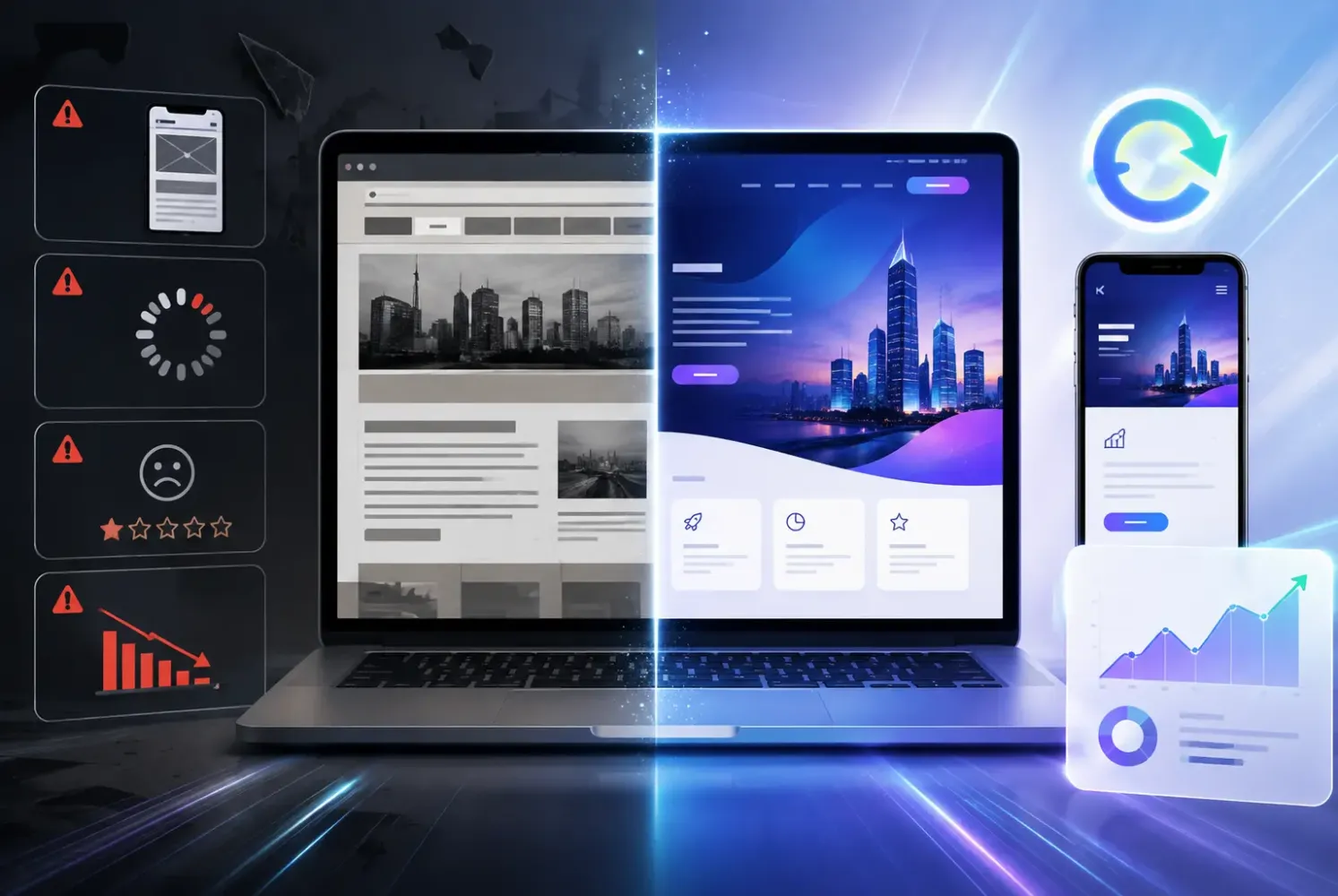
Your business website may still be up: the pages still load and the forms can still be filled in. But “still alive” does not mean “still working”. Many business owners only realise they need a website redesign after traffic has slowly dropped, enquiries have dried up and potential customers have started finding competitors first on Google.
The good news is that you can spot the need for a website redesign long before sales fall off a cliff. The signs are fairly clear if you know where to look. This article sums up seven of them, plus safe steps for rebuilding your website without losing the rankings you worked so hard for.
Why a website redesign is about more than looks
First impressions form very quickly. A round-up of web design statistics from Digital Silk cites research finding that around 94% of first impressions of a site relate to its design, and that this visual judgement forms in about 0.05 seconds. In other words, the decision to stay or leave happens before a visitor has read a single sentence.
Speed raises the stakes. Google research found that 53% of mobile site visits are abandoned when a page takes more than three seconds to load. Round-ups of speed statistics also show online store conversion rates falling sharply as load time stretches from one second to four, and every buyer who leaves is revenue lost.
Visitor behaviour has also moved to small screens. More than 60% of web traffic now comes from phones, yet mobile conversion rates still lag behind desktop. A website designed years ago with a “desktop first” mindset is almost certainly losing most of its visitors today. This is the point where a website redesign stops being a cosmetic project and becomes a business decision.
7 signs your business website needs a redesign now
1. It looks a mess on phones
Open your site on a phone and look at it honestly: do you have to zoom in to read the text, are the buttons hard to tap, or does the menu pile up? If so, you are driving away six in ten visitors. Fixing the responsive layout is the most common reason people redesign their website, and it is usually where the results show fastest. Read our guide to Core Web Vitals optimisation as well, to make sure your mobile version is genuinely lightweight.
2. Load times of more than three seconds
Test your home page with PageSpeed Insights. If the scores are red and load time goes past three seconds, the causes often pile up: huge images, too many plugins, a heavy theme and bare-bones hosting. Fixing them one at a time is sometimes enough, but when the foundations themselves are the problem, a website redesign works out more affordable than endless patching. Our business website speed guide covers the order in which to fix things.
3. Organic traffic has been falling for months
Check Search Console for the last six to twelve months. A steady fall in impressions and clicks signals that your content structure, speed or user experience has fallen behind your competitors. Fix the basics first with Google Search Console; if the problem is structural, a full rebuild is usually more effective.
4. Plenty of visitors, but no enquiries
This is a classic symptom: the traffic is there, the conversions are not. Usually it is because potential customers cannot find a call-to-action button, do not know the price, or hesitate because your site shows no social proof. A conversion-focused redesign puts the WhatsApp button, pricing and customer reviews along a clear path, so nobody has to guess.
5. You cannot change the content yourself
If changing a single sentence means waiting for your vendor, your website is holding your business back. One of the main goals of a modern website redesign is independence: you can add service pages, update prices or publish articles without anyone's help. That flexibility also cuts your long-term costs.
6. It no longer represents your business
Businesses grow: services expand, target markets move upmarket and visual identities change. If your website still shows photos, colours and offers from three years ago, it gives the impression of a business that has stopped growing. Bringing your site in line with where your business is today is a legitimate reason for a website redesign, even when the technical side is still fine.
7. Frequent problems and security risks
Outdated themes or plugins, recurring errors and security warnings in the browser are all red flags. As well as damaging trust, vulnerabilities can lead to your site being blocked by search engines. If routine maintenance no longer helps, rebuilding on a clean foundation is much safer. See our article on business website security for a checklist.
How to redesign a website without losing rankings
Save your data before you start
Record your highest-traffic pages, the keywords you already rank for and the inbound links you have. Without this record, you will not know what was lost after the redesign. Take a snapshot of your conversion figures for the last three months as a benchmark too.
Keep your URLs or set up redirects
The most expensive mistake in a website redesign is changing the URL structure without 301 redirects. Rankings built up over years can vanish overnight. Keep the old addresses where possible; if they have to change, map each one to the most relevant new page.
Design around the customer journey, not personal taste
Start with the questions potential customers usually ask: what is the service, how much does it cost, why should I trust you and how do I order? Arrange your pages in that order. A site that answers questions in a natural order almost always beats one that only looks pretty.
Test on phones before launch
Test every important page on several screen sizes, rather than only on the designer's monitor. Check the buttons, forms and speed. Make sure all pages are indexed and that the new sitemap is submitted to Search Console on launch day.
Measure for 30-90 days
Small fluctuations in the first week are normal. Compare traffic, keyword positions and the number of leads at 30, 60 and 90 days after launch. That tells you whether the redesign worked or needs further adjustment.
When to fix and when to rebuild completely
Not every problem calls for a big project. If your site is fast, secure and easy to manage but simply does not sell well enough, rewriting the service pages and tidying up the call-to-action buttons is often enough. On the other hand, if you ticked four or more of the signs above, especially speed, mobile and security all at once, piecemeal fixes only postpone the cost.
Think about the platform too. WordPress with a lightweight theme suits most businesses that want to manage their own content, while a Next.js-based approach makes sense for sites with high performance demands. We compare the two in our article on choosing a business website platform.
Finally, set aside a maintenance budget for after the redesign. A website is never really finished: it needs regular updates so those warning signs do not come back two years from now.
Start your business website redesign with Webzoo
If you found yourself nodding more than three times while reading the list above, your site really does need some attention. The Webzoo website development team regularly handles website redesigns for small businesses and companies across Greater Jakarta (Jabodetabek), from auditing the current site and mapping URL redirects through to a launch that keeps your rankings safe.
Tell us about your site, and we will help you decide what just needs fixing and what is worth rebuilding. A properly planned website redesign is an investment rather than an expense, and it pays for itself through the leads that finally find you.