

If one digital marketing trend will shape your business's fortunes this year more than any other, it is first-party data. Put simply, first-party data is customer data you collect yourself, directly and legally, from your website, forms, transactions, WhatsApp chats and loyalty programmes. Unlike third-party data, which is bought or borrowed from other platforms, this data really belongs to you, and no change in browser policy can switch it off overnight.
For years, Indonesian marketers relied on third-party cookies to target audiences. But the ecosystem has changed. Safari and Firefox block cross-site tracking by default, and although Google dropped its plan to remove third-party cookies from Chrome entirely in April 2025, the accuracy of cookie-based targeting keeps falling. That is why first-party data has moved up a level, from a useful extra to the foundation of a digital marketing strategy.
Why first-party data is the most important industry trend of 2026
The following numbers explain why companies are racing to strengthen their own data assets. Around 92% of organisations are increasing investment in in-house data strategies because of changing privacy rules (TechRT, 2026), while 78% of marketers say the data they collect themselves is their most valuable data source (TechRT, 2026). The impact is real: campaigns powered by first-party data are reported to deliver up to 50% higher ROI (FirstPartyData.com, 2026).
The market is growing too. According to the 2026 survey by APJII, the Indonesian Internet Service Providers Association, Indonesia now has 235.26 million internet users, a penetration rate of 81.72% (APJII, 2026), and 84.31% of them go online through their mobile phones. That means millions of digital interactions happen every day that you could turn into customer data, provided you set up the system first.
In addition, 75% of companies plan to reduce their reliance on third-party data during 2026 (TechRT, 2026). So if your business has no similar plan, you risk falling behind competitors who have already started.
How is first-party data different from third-party data?
Third-party data is collected by other companies, then sold or shared. Its quality often cannot be verified, and you have no control when the source stops operating. Data you own, by contrast, comes from a direct relationship with your customers, so it is far more accurate, less costly in the long run and safer from a legal point of view. For Indonesian businesses, that last point matters because the Personal Data Protection Law (UU PDP, Law No. 27 of 2022) is now fully in force.
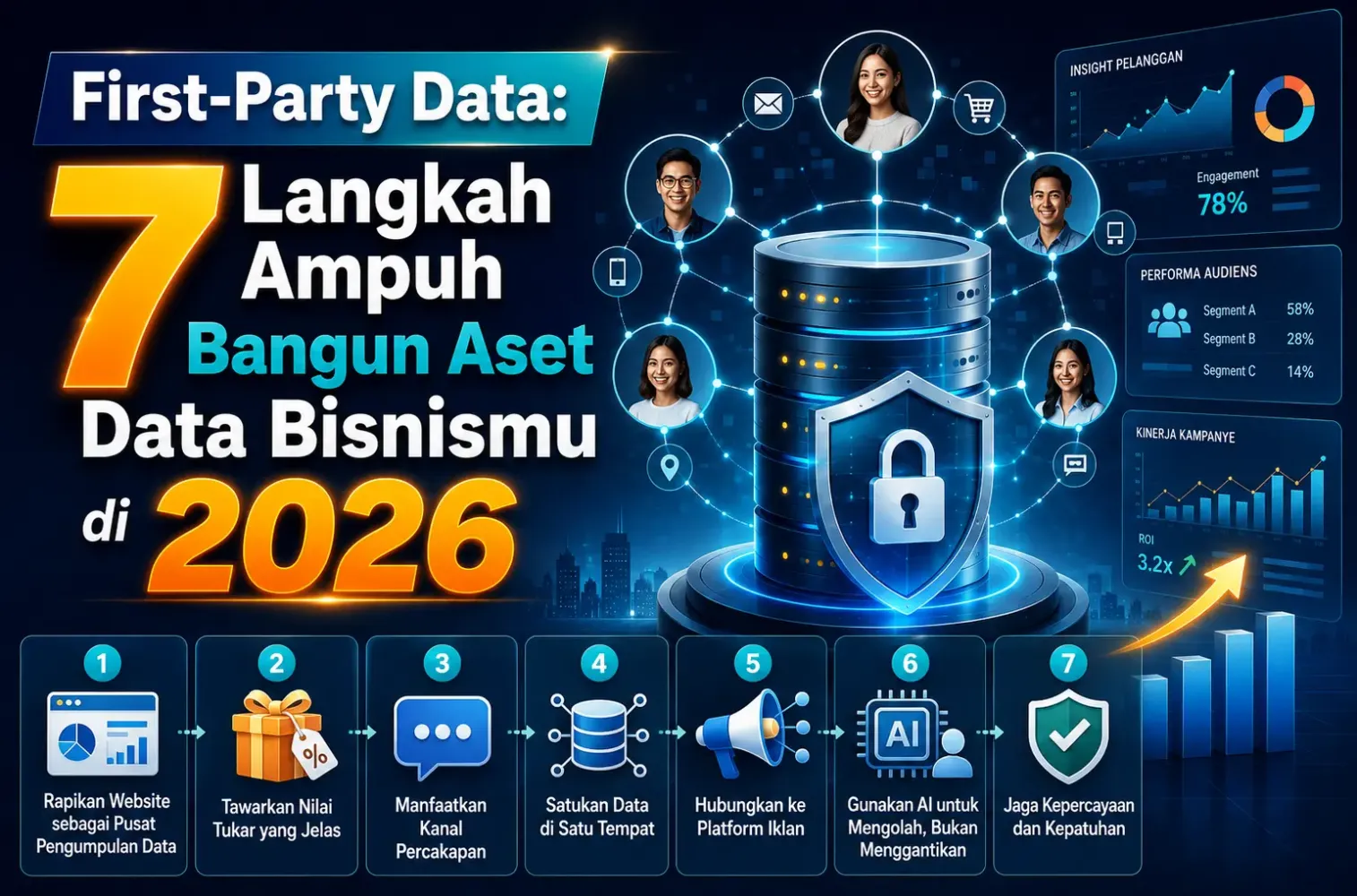
7 steps to build first-party data for an Indonesian business
The good news is that building a data asset does not have to be expensive. Here are seven steps you can take one at a time.
1. Make your website the hub for data collection
Your website is the ideal place to collect first-party data because you have full control over it. Make sure it has a clear contact form, newsletter sign-up and WhatsApp button. A slow site makes visitors leave before they fill anything in, so check its performance regularly in Google Search Console as well.
2. Offer a clear value exchange
People do not hand over their WhatsApp number or email address without a reason. Offer something concrete: a first-order discount, a PDF guide, a price calculator or a free class. The more closely the offer matches your customers' problems, the more data comes in.
3. Use your conversation channels
Chat is a goldmine of first-party data that is often overlooked. Record customers' preferences, purchase history and objections from everyday conversations. If WhatsApp is your main channel, use labels and notes so the data stays structured rather than scattered across hundreds of chats.
4. Bring your data together in one place
Data scattered across spreadsheets, the till and Instagram DMs is of little use. Combine it all in one simple CRM. Even a well-organised Google Sheet is enough to start with, as long as the format is consistent: name, contact details, source, date and status.
5. Connect it to your ad platforms
This is where you feel the impact straight away. Upload your customer list to Google Ads or Meta Ads as a custom audience, then create lookalike audiences. That way, your ad budget is no longer based on guesswork. You can also combine this with a local SEO strategy, so nearby customers find you more easily without extra ad spend.
6. Use AI to process your data, not to replace it
AI tools such as Claude and Gemini are very helpful for summarising purchase patterns or building segments. But remember that AI is only as good as the data you give it. You can read a practical guide in our comparison of Claude AI and Gemini, and for organic optimisation there is also a list of AI tools for SEO worth trying.
7. Protect trust and stay compliant
Always ask for clear consent, explain how the data will be used and provide an option to unsubscribe. Trust is what keeps first-party data flowing, and once it is lost, rebuilding your data is far more expensive.
An illustration: a building supplies shop in Bekasi
Imagine a building supplies shop in Bekasi that has relied only on search ads with broad location targeting. Every month the budget runs out, but the buyers who come in often just ask about prices and leave. Once the owner starts recording phone numbers, the materials bought and the transaction dates in a single spreadsheet, the picture changes dramatically.
From the 400 contacts collected over three months, it becomes clear that most repeat buyers are small contractors who order every two to three weeks. This simple insight is then used for two things: sending new stock offers on WhatsApp just before each buying cycle, and uploading the contact list to Google Ads as a custom audience. As a result, the cost per order falls, because the ads no longer reach irrelevant people.
Interestingly, no expensive technology is involved. All it takes is the discipline to keep records and the willingness to use the data. This is the power of first-party data for small businesses: a competitive advantage built from daily habits rather than a big budget. Competitors can copy your website design in a day, but they cannot copy a customer list you have built over years.
Common mistakes to avoid
The most common mistake is collecting data with no plan for using it, so it piles up without adding value. Another is asking for too much information up front; a form with ten fields is almost certain to be abandoned. Finally, remember to clean out old data regularly so your segmentation stays accurate. The content that supports data collection also needs updating, and you can find the latest techniques in our on-page SEO 2026 guide.
Where to start today
Choose one channel, one form and one offer. Run them for 30 days, measure how many new contacts come in, then expand. A gradual approach like this has proven more sustainable than buying an expensive system that ends up unused. Industry research shows that companies that make the most of first-party data record up to 2.9 times more revenue growth than their competitors (TechRT, 2026).
If you want your website, SEO and Google Ads to work together to collect first-party data automatically, the Webzoo team can help, from planning through to execution. The consultation is free, and you can start at the smallest scale. What matters is starting today, because the best data assets are always built early, well before a campaign is already running.


