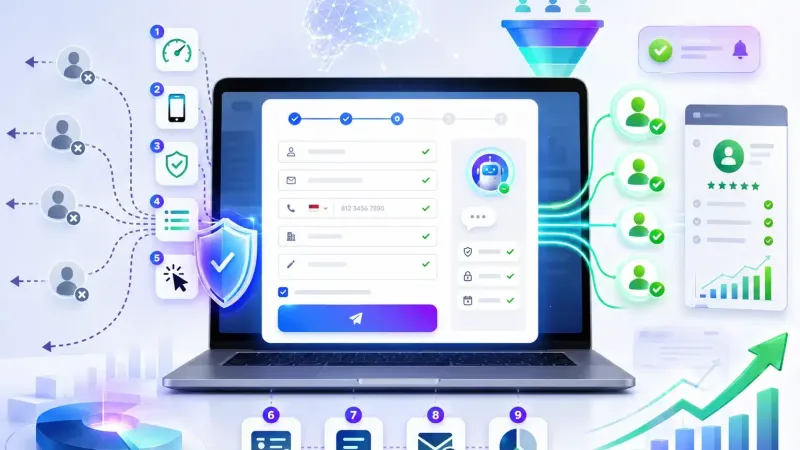
A website as fast as an app: what a progressive web app does
Imagine a customer opening your shop's website and the page loading as quickly as an app on their phone, with the option to install it on the home screen without going near the Play Store. That is what a progressive web app offers. It is a modern way of building websites that combines the speed of a native app with the wide reach of a website. Most Indonesian customers browse on their phones, so for business owners here this technology is a practical way to increase sales.
Many small businesses (UMKM) still think building an app is expensive and complicated, while an ordinary website feels slow on an unstable connection. A progressive web app fills exactly that gap. This article explains what a PWA is, the data behind it, its seven main benefits and the practical steps to put it to work for your business in 2026.
What is a progressive web app?
Put simply, a progressive web app is a website built with standard web technology (HTML, CSS, JavaScript) that behaves like an app. It can be installed on a phone's home screen, loads content quickly, sends notifications and even keeps working partly when the internet connection is weak or drops out. The user never has to download anything from an app store.
The key component is the service worker, a script that runs in the background and caches important files. Thanks to this mechanism, return visits feel much lighter. So instead of choosing between a website and an app, a PWA gives you both at the same web address.
How it differs from a regular website and a native app
A regular website is easy to reach, but it is often slow and cannot “stick” to the user's phone. A native app (downloaded from an app store) is fast and full of features, but it is expensive to build and users have to be willing to download it. A progressive web app takes the middle road: as easy to build and reach as a website, and as fast as an app in use. For many small businesses, that middle road makes the most sense in terms of both cost and results.
The data that makes progressive web apps worth a look
Before getting to the benefits, here are the numbers that explain why this approach matters, especially in the Indonesian market:
- Indonesia had 229.4 million internet users in 2025, a penetration rate of 80.66% (APJII, 2025).
- 83.39% of users access the internet mainly on a smartphone, which confirms how mobile-first Indonesian consumers are (APJII, 2025).
- The global progressive web app market is forecast to grow from US$5.23 billion in 2025 to US$21.44 billion in 2033, a CAGR of 18.98% (Straits Research, 2025).
- The classic Alibaba case study recorded a 76% increase in conversions across browsers after the switch to a PWA (Google web.dev, case study archive).
The first two facts matter most when taken together. Nearly all of your customers arrive on a small screen over a network of varying quality. That is where progressive web apps have the edge, because they are designed to stay light and responsive in exactly these less-than-ideal conditions.
7 benefits of a progressive web app for your business website
These are the concrete benefits you can expect when your business website becomes a progressive web app.
1. Load times that feel instant
Because a PWA caches its assets, pages you revisit open almost immediately. This speed matters because every second of delay increases the number of visitors who leave. If you want to understand speed metrics in more depth, our guide to Core Web Vitals optimisation is a useful companion.
2. Installable without an app store
Visitors just tap “Add to Home Screen” and your website's icon sits on their phone like an app. There is no heavy download and no fee to publish on the Play Store or App Store. An icon on the home screen makes your brand easier to remember and to open again.
3. Keeps working on a weak connection
Thanks to the service worker, pages that have been opened before remain available even when the signal comes and goes. For businesses serving customers in areas with patchy coverage, this offline capability keeps the experience smooth and reduces lost transactions.
4. Lower cost than a native app
Building separate Android and iOS apps means two teams, two codebases and costs that multiply. A progressive web app is built once and runs on every device through the browser. For small businesses on a limited budget, that efficiency makes a real difference.
5. Notifications that bring customers back
PWAs support push notifications, so you can remind customers about promotions, abandoned carts or new products, just as an app would. This becomes a free marketing channel that helps increase return visits and repeat sales.
6. SEO-friendly and easy to find
Because it is still web-based, every page of a progressive web app can be indexed by Google, unlike a native app that is “hidden” inside an app store. You keep getting organic traffic from search. Good speed and a good mobile experience are positive ranking signals too, in line with the principles of responsive mobile-first design.
7. Higher conversions and engagement
All of the benefits above lead to healthier business numbers: longer sessions, more pages viewed and higher conversions. A fast, comfortable experience makes visitors more willing to buy. To get the most from it, combine your PWA with a strategy for increasing online shop conversions so that every visit is worth more.
When should your business switch to a PWA?
Not every business needs to rush. There are, however, some strong signs that a progressive web app is worth considering now. The first is that most of your traffic comes from phones, which is almost certain given that 83% of Indonesian users are mobile-first. The second is that you want app-like features but cannot yet fund native development. The third is that customers often complain the website feels slow or eats up their mobile data.
On the other hand, if your website is very simple and rarely gets return visits, a PWA can wait. Weigh your customers' behaviour and your business goals before following the trend. A sound technical foundation, including website speed optimisation, still has to be in place before you add the PWA layer.
How to get started in practice
Work through the steps in order: make sure the website is already fast and responsive, add a manifest file so it can be installed, activate a service worker for caching and offline mode, and install an HTTPS certificate, which is mandatory. Modern platforms such as Next.js have strong support for building progressive web apps, as does WordPress with the right plugin. Google's official Progressive Web Apps documentation on web.dev is a reliable technical reference.
Build your progressive web app with a professional team
Turning a website into a stable PWA takes the right mix of design, performance work and engineering. A misconfigured service worker, for example, can leave old content “frozen” on users' screens. This is where an experienced team saves you time and steers you clear of technical traps. Webzoo helps businesses build fast, responsive, PWA-ready websites through our professional website development service, on WordPress or Next.js.
In the end, a progressive web app is about giving customers the fastest and easiest way to buy from you, whatever the latest technology happens to be. In a market that is 83% mobile-first, even a small edge in speed and convenience can decide whether a visitor leaves or becomes a paying customer. Start with a strong website foundation, then let a progressive web app take your business a step further.
References
- APJII, “Indonesian Internet User Profile 2025” (229.4 million users, 83.39% via smartphone): apjii.or.id
- Straits Research, “Progressive Web Apps (PWA) Market Size, Growth & Trends” (2025): straitsresearch.com
- Google web.dev, “Explore Progressive Web Apps”: web.dev