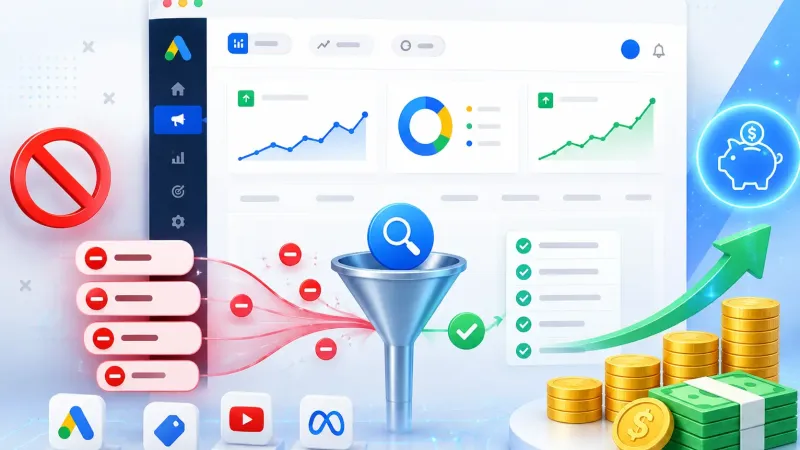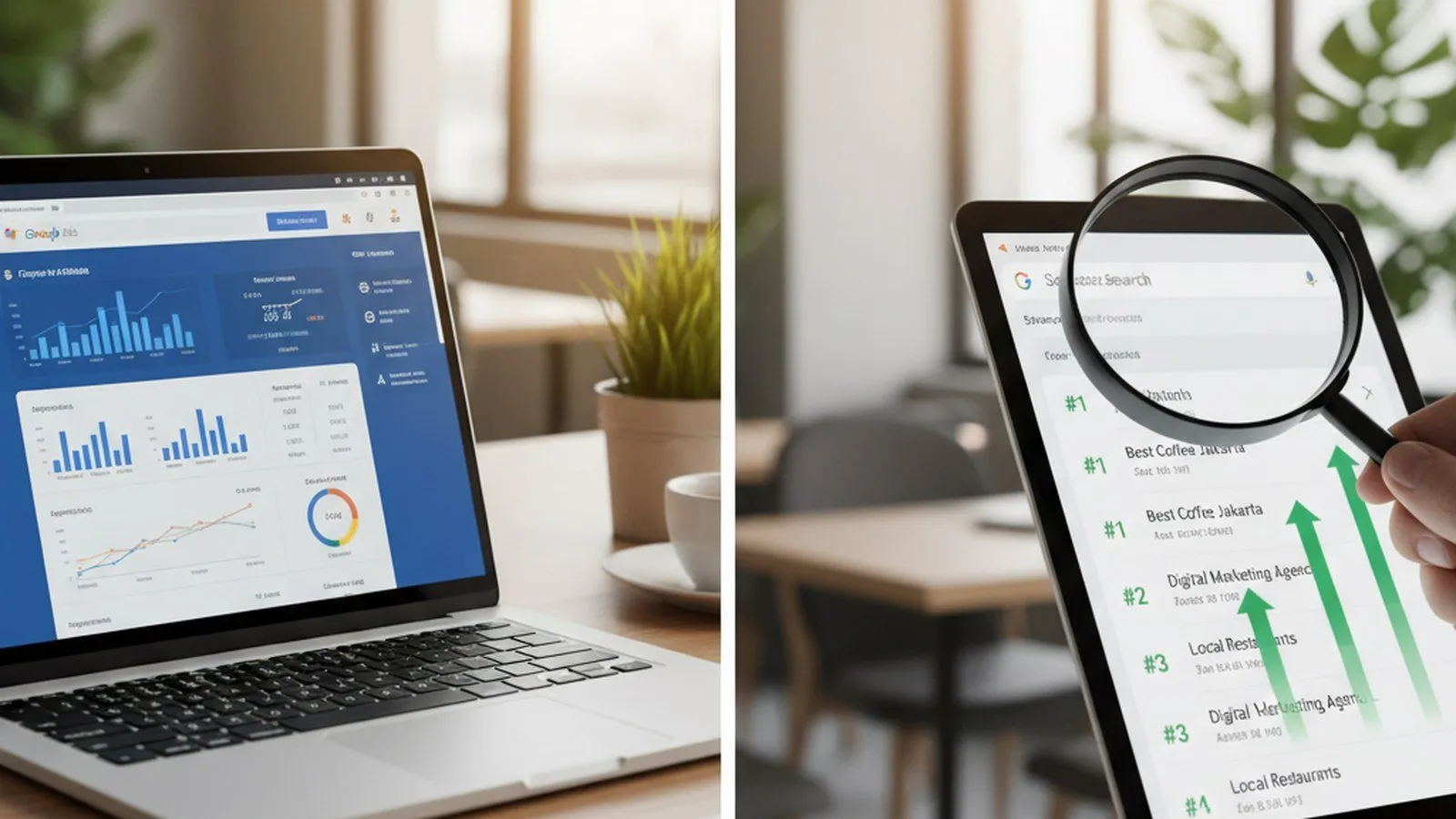
This question comes up in every digital marketing strategy meeting: Google Ads vs SEO, which one should we invest in? Spoiler: in most cases the answer is both, because their strengths complement each other. But if your budget is limited and you have to choose one first, the answer depends on three factors: how quickly you need results, how big a budget you can sustain, and the nature of your product or service.
This guide compares Google Ads and SEO across 7 dimensions: cost, time to results, short-term versus long-term ROI, traffic quality, competitive control, sustainability, and when each one works best. It finishes with a decision framework for Indonesian businesses based on their stage of growth.
Key points in this article
- Google Ads delivers instant results (within the first hour); SEO delivers compounding results (from month 6 onwards)
- Short-term cost: SEO costs less. Long-term cost: SEO costs far less, because you do not pay per click
- Conversion rates are almost the same (3-7% for Ads, 2-5% for SEO); the difference lies in trust signals
- SEO builds a competitive moat that is hard to copy, while competitors can outbid your ads within hours
- The best strategy for most businesses is to combine both, with the right timing for each stage
The fundamental difference: pay-per-click vs earned traffic
Before comparing them, understand that the two work in fundamentally different ways. With Google Ads, you pay to appear in premium positions on the SERP, and when the budget runs out, the traffic stops. SEO is organic optimisation to appear in positions 1-10 of the search results. Once you have the rankings, the traffic keeps coming with no cost per click.
A simple analogy: Google Ads is like renting a premium billboard on Jalan Sudirman, Jakarta's main business street (visible straight away, paid monthly). SEO is like putting up your own building in a prime location (slow and capital-intensive at first, but once it stands, it is a lasting asset).

Dimension 1: Cost. How much budget do you need?
Google Ads in Indonesia in 2026: the average cost per click is Rp 1,500-15,000 depending on the industry. Competitive industries (insurance, property, legal) can reach Rp 50,000+ per click. The minimum effective budget for testing is Rp 3-5 million a month. For significant scale: Rp 10-30 million a month.
With SEO, the main costs are time and content production. Estimates:
- DIY (in-house): 20-40 hours a month of your or your team's time. Equivalent cost: Rp 3-10 million a month (if you count the opportunity cost).
- SEO freelancer plus content writer: Rp 5-15 million a month for 4-8 quality articles plus optimisation.
- SEO agency: Rp 10-50 million a month depending on scope (audit, content, link building, technical).
Short-term cost winner: SEO costs less (if done in-house). Long-term cost winner: SEO costs far less, because you do not pay per click.
Dimension 2: Time to results. When does traffic start flowing?
Google Ads: traffic starts in the first hour after a campaign goes live, and you can generate leads or sales on day 1. Impact timeline: instant.
SEO: rankings only appear after Google has indexed and evaluated your content. A realistic timeline for a new website:
- Months 1-3: pages indexed, with long-tail keywords ranking in positions 30-50
- Months 4-6: long-tail rankings rise to positions 10-20 and organic traffic starts to arrive
- Months 6-12: medium-difficulty keywords rank in the top 10, bringing significant traffic
- Month 12+: stable top 5 rankings for your main keywords
Speed winner: Google Ads, by a long way. But speed is not the only thing that matters.
Dimension 3: Short-term vs long-term ROI
Google Ads ROI: with an optimised campaign, a realistic ROAS (return on ad spend) is 3-8x in ordinary industries and 1.5-3x in competitive ones. The return stops when the budget stops, so it has an “expiry date”.
SEO ROI compounds. An article that ranks in year 1 keeps driving traffic in years 2-5+ at no extra cost. The investment takes patience. Months 1-6: negative ROI (you are spending before the results arrive). Month 12+: ROI turns positive and compounds.
A financial analogy: Google Ads is like renting a flat (steady cash flow, but you build no equity). SEO is like buying a house with a mortgage, known in Indonesia as KPR (negative cash flow in the early years, with equity growing over time).
Dimension 4: Traffic quality and conversion rate
Myth: paid traffic converts better. What the industry data says:
- Google Ads conversion rate (search ads, not display): 3-7% for B2C and 1-3% for B2B in Indonesia.
- SEO organic conversion rate: 2-5% for B2C and 1-3% for B2B. Slightly lower than Ads, but not significantly.
Why is the quality similar? Because the search intent is the same: users looking at organic results and users looking at ads are both searching for a solution. The only difference is where the result appears. In fact, SEO often carries a stronger trust signal, because users know organic results are “earned” rather than paid placements.
Dimension 5: Control over competitors
Google Ads: a competitor can bid higher and take your position within the first hour. A bidding war pushes up the cost per click for everyone. There is no moat.
SEO: organic rankings are influenced by hundreds of algorithm signals, so competitors cannot “buy” your position. If you rank #1 on the strength of content quality and authority, a competitor needs months to overtake you. SEO builds a competitive moat.
Dimension 6: Sustainability and resilience
Google Ads is vulnerable to rising CPCs driven by competitors, changes to the Ads algorithm, account suspensions (which often happen without warning), and tight cash flow (if you have to switch campaigns off, traffic drops to zero).
SEO is vulnerable to Google algorithm updates (Helpful Content and core updates can drop rankings), competitors outranking you, and changes in search behaviour (the rise of zero-click searches). But with a white-hat strategy and high-quality content, recovery is more predictable.
Resilience winner: SEO (when it is built properly).
Dimension 7: When to choose Google Ads and when to choose SEO
Choose Google Ads if:
- You need traffic as soon as possible (a product launch, a time-bound event, seasonal competition)
- Your website is new and has no authority: SEO takes time, while ads can start straight away
- Your product margins are high, so you can absorb high CPCs and still make a profit
- You are testing the market (validating keywords, audiences and messaging before investing in SEO)
- Your business is seasonal (Ramadan retail, year-end property): SEO is too slow for a short window
Choose SEO if:
- Your marketing budget is limited but you have the time or people for content production
- Your industry is evergreen (services, education, software), so content will still be relevant next year
- Your goal is long-term brand authority and thought leadership
- Your product has a long research cycle (B2B, high-ticket), so buyers read a lot of content before deciding
- You want a scalable marketing asset without linear costs (no paying per visitor)
Combining Google Ads and SEO: the better route for most businesses
Most successful businesses do not pick one. They combine both, with the right timing:
- Months 1-6: run Google Ads to test keywords and audiences and get instant traffic. In parallel, start building your SEO content foundation.
- Months 6-12: as SEO starts bringing in traffic, reduce ad spend on keywords that already rank in the organic top 5 (cutting costs). Keep using ads for new keywords or ones that do not rank yet.
- Month 12+: dominate the SERP by appearing in organic positions #1-3 and in the ad slots. Maximum coverage and a high share of voice.
Large businesses (mobile phones, automotive, property, e-commerce) mostly use this combination. New small businesses can start with one (usually ads to validate the market, then build SEO).
References
- Google Ads Help: Quality Score & Auction
- Google Search Central: SEO Starter Guide
- WordStream: Google Ads Industry Benchmarks
- Ahrefs: SEO vs PPC: Pros, Cons, and How to Choose
- Search Engine Journal: SEO vs PPC: Which is Better?
If your business is just starting out and needs traffic quickly, use our Google Ads guide for Indonesian businesses as a foundation. For a long-term SEO strategy, start with the SEO fundamentals and local keyword research. Combine the two for the best results. Webzoo also offers SEO services carried out by a professional team. Book a consultation if you would like our help.
More articles you may find useful
- Google Ads Guide for Indonesian Businesses: From Zero to Profit
- What Is SEO? A Complete Guide for Beginners
- On-Page SEO Techniques That Still Work in 2026
- Link Building Strategies for Indonesia in 2026
Need help from the Webzoo team?
Book a free consultation with our specialists to find the right solution for your business.