

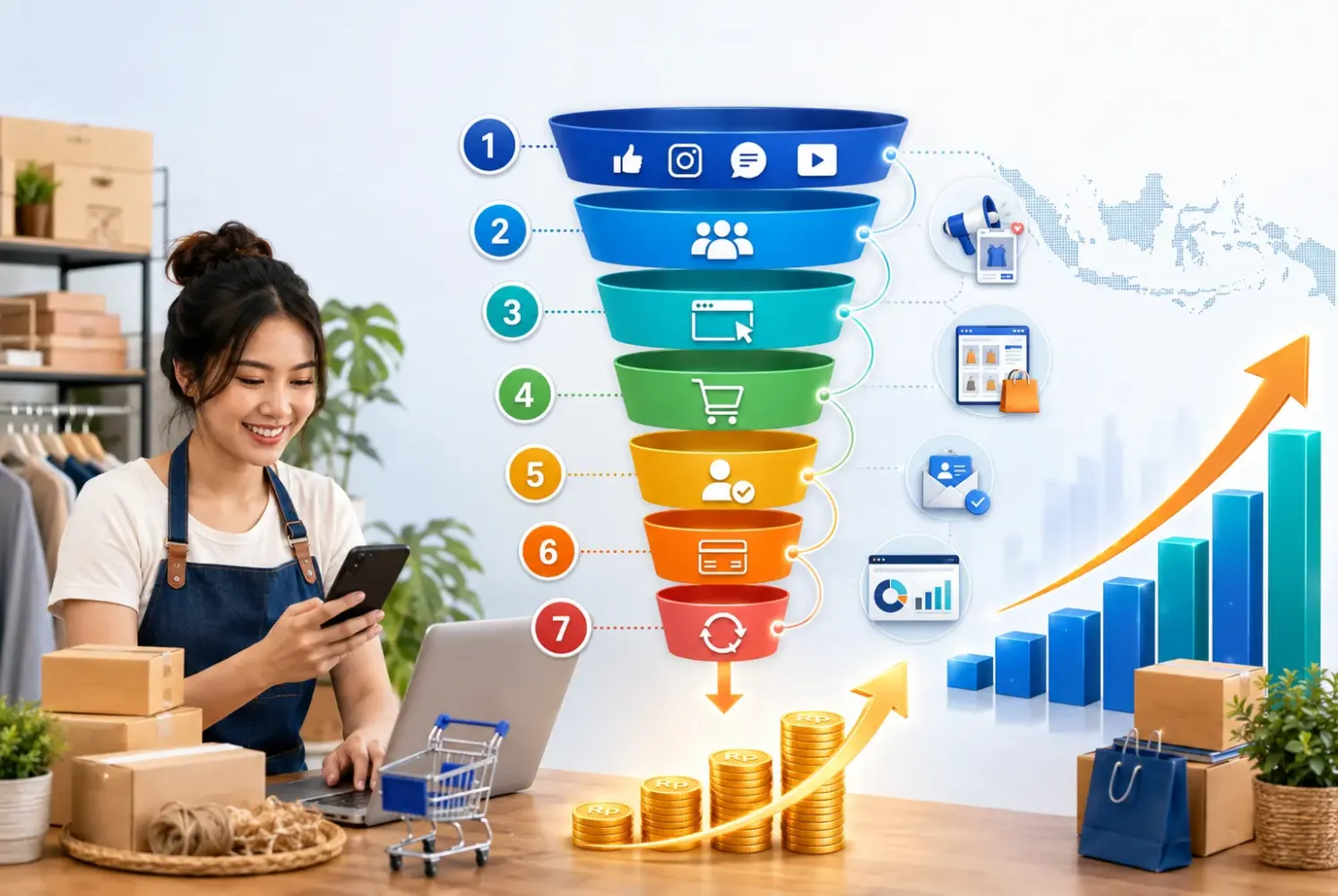
Many business owners already have a website, marketplace accounts and ads running, yet revenue stays flat. The problem rarely lies with the product. It usually lies in a leaky digital sales funnel. Without a clear path, potential buyers arrive, look around briefly and leave without a trace. The opportunity is large: the value of national e-commerce is forecast to grow from USD 90.35 billion in 2025 to USD 104.21 billion in 2026 (Mordor Intelligence, 2026).
The good news is that building this path is less complicated than it sounds. This article sets out seven practical steps you can put into practice this week.
What is a digital sales funnel and why does it matter?
Put simply, a digital sales funnel is a map of the potential customer's journey from the moment they first come across your business to the point where they buy, and buy again. It is shaped like a funnel because the number of people shrinks at every stage: many see you, some click, a few ask questions and fewer still pay.
Why does it matter? Without this map, your promotional budget goes on drawing people to a front door that turns out to be locked. Industry data shows that in 2025 more than 70% of small businesses (UMKM) in Indonesia were already using marketplaces such as Tokopedia, Shopee or TikTok Shop as their main channel, and 63% were actively using digital tools in their operations (FounderPlus, 2026). The presence is already there; what is missing is a clear path.
The five stages you need to know
- Awareness: people find your business through Google, social media or a recommendation.
- Interest: they read your content and start comparing.
- Consideration: they check prices, reviews and evidence that you are credible.
- Purchase: the transaction happens.
- Loyalty: they come back and recommend you.
7 steps to building a clear digital sales funnel
1. Map the journey before you spend on ads
Before you add to your budget, sketch the customer journey on a sheet of paper. Mark the points where most people drop off. A healthy digital sales funnel always starts with understanding the journey, long before anyone presses the “boost” button.
2. Fix your organic entry points
Google search is still the lowest-cost source of potential buyers. Make sure your service pages appear for the keywords people actually search for. Start with the basics, such as proven on-page SEO techniques, and if your business serves a particular area, also tidy up your local SEO so you appear on Google Maps.
3. Make sure your website is fast and convincing
Your website sits at the centre of your digital sales funnel. A slow page makes visitors leave before they see your offer. Monitor your Core Web Vitals (LCP under 2.5 seconds, INP under 200 ms and CLS under 0.1, according to Google, 2026) through Google Search Console. If your site's design is out of date, consider reinvesting, starting by understanding the cost of a professional website in Indonesia.
4. Add content that answers doubts
At the consideration stage, people look for reasons to trust you. Provide an FAQ page, case studies and testimonials with real names and photos. This kind of content fills the middle of the digital sales funnel, the part that is most often forgotten.
5. Open a fast conversation channel
Next, make it easy for people to ask questions. WhatsApp, a short form or a no-code chatbot can capture potential buyers who are not ready to pay today. The shorter the gap between curiosity and an answer, the healthier your digital sales funnel.
6. Speed things up with paid ads once the foundations are ready
Ads work best when the page they lead to is already in good shape. Learn the basics of targeting and campaign structure in our Google Ads guide for Indonesian businesses. That way, every rupiah of ad spend goes into a digital sales funnel that is ready to convert, instead of into a leaky page.
7. Measure, then fix one point each month
The big marketplaces already provide free data: how many people view a product, how many click and how many buy. Unfortunately, most sellers never read it. Fixing one leak a month is far more effective than overhauling everything at once.
An example of a digital sales funnel in a small business
To make this more concrete, picture a baby goods shop in Bekasi whose revenue has stalled. The owner already advertises on social media, but the messages that come in rarely turn into purchases. Once the path was mapped, it turned out the ads led to a social media profile instead of a clear product page. Potential buyers had to find the price and how to order by themselves, and most of them gave up halfway.
The fix was simple. First, a short offer page was created with product photos, transparent prices, shipping costs and a WhatsApp button that opens with a pre-filled greeting. Second, a customer review section with real photos was added to settle doubts. Third, an automatic reminder was set up for people who had asked a question but not paid within three days.
The result came from removing obstacles, with nothing magical about it. When every stage has one clear job, the digital sales funnel stops leaking at the small points that had gone unnoticed. The same ad budget ends up producing more good-quality conversations.
Lessons you can copy
Notice that the example used no expensive technology. Only the order and clarity changed. That is the core of building a digital sales funnel for a small business: one goal per page, one call to action that stands out and one communication channel that gets quick replies. The fewer decisions visitors have to make, the more likely they are to move on to the next stage.
Common mistakes that make a funnel leak
The first is focusing too much on visitor numbers and ignoring their quality. The second is giving everyone the same message, when potential buyers at the awareness stage need education and those at the purchase stage need certainty about price. The third is never following up with people who have already visited.
On top of that, many businesses stop at the first transaction. Yet the loyalty stage is the lowest-cost part of the whole digital sales funnel, because existing customers do not have to be convinced from scratch.
Where to start today
Take the stage that has the most problems, work on it for two weeks, then measure the results. If you would like someone to talk it through with, the Webzoo team regularly helps small businesses bring their website, SEO and ad campaigns together so they work as one. In the end, a well-organised digital sales funnel depends on removing the small obstacles that make potential buyers change their minds, and expensive tools have little to do with it. Clear up the path, and your sales figures will follow.


